

What Is 6/6 Vision? Meaning and Eye Chart Letters Explained

Remember the times you had to queue up and wait your turn for an eye care consultation in Singapore? Feeling nervous and unsure of what small letters are on the screen? Being simply told that 6/6 or 6/9 vision was fine but unsure of what those numbers entailed?
Here are some ways to understand these measurements:
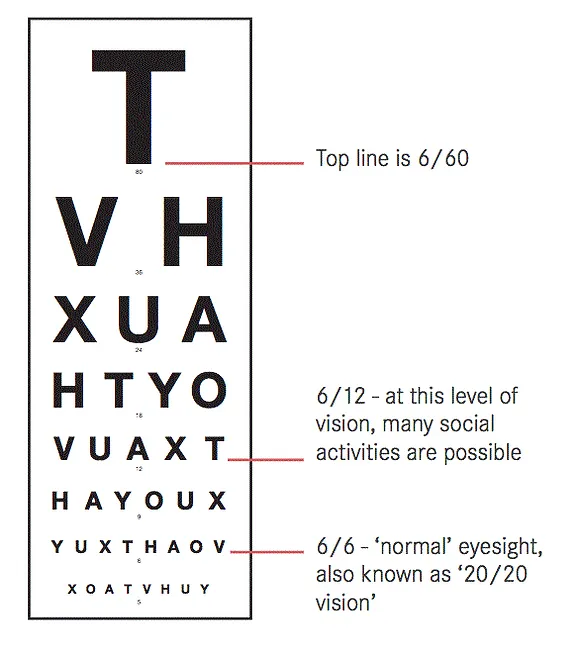
Numbers like 6/6 or 6/9 are frequently tossed around but what they represent is your Visual Acuity (VA). VA is measured through your ability to identify letters or numbers in a controlled environment where the distance and charts are fixed.
Being able to identify the smallest line on a chart, the 6/6 line qualifies you to have ‘normal’ VA. Though most charts also contain lines smaller than the 6/6 line.
The increasingly larger letters above the 6/6 line represent correspondingly with increasing VA values such as 6/9, 6/12, 6/18, and so on. Similarly, smaller letters correspond to smaller VA values.
To understand the two numbers that make up a VA value: the first number is the testing distance (6 metres), and the second is the distance at which a person with normal vision can read the same letter. A person with normal vision can read the 6/60 letter from 60 metres away. If you can only read it at 6 metres, your visual acuity is 6/60.
The largest letter on most eye charts are usually 6/60, and according to the World Health Organization (WHO), having only the ability to read this letter even with the best glasses or contact lenses would certify you as being severely visually impaired and legally blind.
VA is always measured with your best correction in place, such as your glasses or contact lenses. What this describes is that the blurry vision in the morning before you put on your glasses or contact lenses counts as uncorrected vision and hence not a proper depiction of your VA.
How big is a 6/6 letter? On a chart read from 6 metres, a 6/6 letter is about 8.7 mm tall, just under 1 cm. Each letter is sized so that its full height takes up 5 minutes of arc at that distance (1 minute of arc is 1/60 of a degree).