

Comprehensive Eye Examination

A comprehensive eye exam in Singapore at EMME Visioncare is a thorough 30–40 minute assessment of both your eyesight and the health of your eyes — far more than a simple prescription update.
Every comprehensive eye test is carried out by a qualified optometrist, never a retail associate, so an optometrist eye exam here both measures how clearly you see and screens for eye conditions that often develop without symptoms. Whether you are booking a routine eye check up, an optometrist vision test, or a full eye health review, you are in qualified hands from start to finish. If you are looking for where to get your eyesight checked in Singapore, you have come to the right place.
Why Us
Detailed Eye Examinations
Our full eye examinations take 30–40 minutes — enough time to thoroughly check both your vision and the health of your eyes, without ever feeling rushed. We talk you through what we find, discuss any eye health issues in plain language, and show you digital images of the inside of your eyes. You'll leave with a clear understanding of your own eyes and practical advice on how to care for them.
Advance Digital Eye Care
Digital eye care technology lets us measure your vision more precisely and capture detailed images of the front and back of your eyes during your eye check up. By tracking these images over time, we can pinpoint small changes early — often before you'd notice any symptoms yourself. That's the heart of our preventative approach at EMME Visioncare: catching potential issues sooner, when they're most treatable.
Evidence-Based Eye Care Approach
Every treatment plan we recommend is grounded in the latest peer-reviewed research, drawing on the best clinical evidence from both Singapore and overseas. We pay particularly close attention to childhood myopia control — so as new myopia treatments and products are validated and reach Singapore, you'll hear about them from us early.
Clear & Simple
You'll leave your consultation understanding your results — not just hearing them. We explain what we've found about your eyes, or your children's, in clear, plain language, so any prescription changes or eye conditions make sense to you. For children, we also provide a concise written report to take home and a copy for your child's teacher, so everyone supporting their learning is on the same page.
True Independence
We're an independent, family-owned practice, so our advice is never tied to a single supplier. Unlike corporate chains that stock a limited set of preferred brands, we recommend eyewear and lenses from a far wider range of suppliers — choosing what suits your eyes and your lifestyle, not what a commercial partnership dictates.
Eye Care You Can Trust
Every clinical test and eye screening at EMME Visioncare is carried out by our optometrist — never a retail associate. With more than 10 years of clinical experience in Singapore, our optometrist can manage many eye conditions, including eye infections, inflammation and glaucoma. From your first test to your final recommendation, you're in qualified hands the whole way through.
Detailed Vision Check
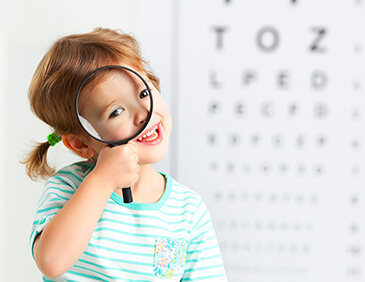
The first stage of your eye check up measures how well you see and whether your prescription needs updating. Our optometrist records your current vision and the prescription of any glasses you already wear, then takes a digital baseline measurement of your eyes. We check your focusing both at distance and close up, assess how well your eyes work together (binocular vision), and test your colour vision. Together, these tests show whether corrective lenses or a prescription change would help you see at your very best.
External Eye Check
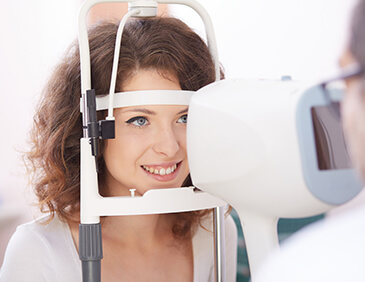
Next, we examine the front surface and structures of your eyes — the part of the exam that screens for cataracts, dry eye and corneal problems, and matters most if you wear contact lenses. We gently measure the pressure inside your eyes to help screen for glaucoma, with no numbing drops needed. If you're considering contact lenses or Ortho-K, we also map the surface of your eye in fine detail using an instrument called a corneal topographer.
Internal Eye Check
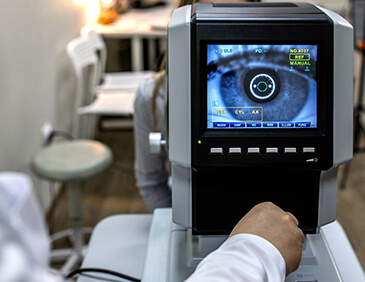
Examining the inside of your eyes is one of the most important parts of protecting your long-term eye health. We check your retina, optic nerve and macula for early signs of serious eye conditions such as glaucoma, macular degeneration and diabetic retinopathy — often before you'd notice any change in your vision. Digital retinal imaging is included for every patient, giving us a record to compare against at future visits so we can catch subtle changes over time. In some cases, we may use dilating drops to widen your pupils and see even further into your eyes.
More than 20/20: the dimensions of healthy vision
Reading clearly on a letter chart is only part of the picture. A comprehensive eye test at EMME Visioncare also assesses how well your eyes work together as a system:
- Accommodation – how well your eyes focus on near objects, and how comfortably they sustain it.
- Colour vision – how accurately you perceive and distinguish colours.
- Depth perception – how well you judge distance and depth.
- Binocular vision – how well your two eyes coordinate to form a single, comfortable image.
- Peripheral vision – how much you can see at the edges of your visual field.
- Contrast sensitivity – how well you distinguish objects from their background, especially in low light.
These functions affect everyday tasks — reading, driving, screen work and sport — which is why our eye check looks beyond the basic prescription.
Eye Care For Everyone

At EMME Visioncare, we believe in quality eye care for all in Singapore.
We're a family optometry practice, testing for all kinds of vision and eye health problems in both adults and children. Whether you're 5, 45 or 70 — short-sighted, long-sighted or living with astigmatism — we provide trusted consultations and treatments tailored to you. Even with good vision, it's wise to have a full eye examination at least once every 2 years, since many eye conditions develop without obvious symptoms. So if you're thinking about a comprehensive eye check up in Singapore — to catch potential issues early or simply as part of regular care — you can trust EMME Visioncare to carry out a thorough examination.

Don't take your vision for granted
Many vision problems are correctable — but some sight loss is permanent, and it often develops slowly and without warning until real damage is done. The best way to protect your vision is to have your eyes examined regularly by an eye care professional, so any potential eye health conditions are picked up and treated while they're still manageable.

Children's Eyesight
Good vision is essential for learning, yet children often don't realise their eyesight has changed — they may struggle to see at school without anyone noticing. We recommend a baseline eye check up before your child starts school in Singapore, and a check every year after that.

Vision Problems
As adults, we can develop difficulty seeing clearly in the distance, up close, or both. Having your vision checked at least once every 2 years helps catch these changes early — and more often if eye diseases such as glaucoma or macular degeneration run in your family.

Eye Health Conditions
Our eyes change as we age, and conditions like cataracts, glaucoma, macular degeneration and diabetic retinopathy become more common over time. Because these often develop without early symptoms, we recommend a full eye examination every year for anyone over 60.
Children’s Eyesight

Too much screen time can trigger digital eye strain in children, leading to tired eyes, headaches and trouble concentrating. Regular eye checks let us spot problems early — when they're easiest to manage.
Eye Care for Children
Children's eye care is a core part of what we do at EMME Visioncare. Our Singapore practice is designed to be kid-friendly, so eye tests and consultations feel relaxed rather than daunting. We have vision charts suitable for children as young as 2, electronic vision measuring for infants, and a full range of tests for everyone from toddlers to teenagers.
If you have any concerns about your child's eyes or eyesight, we can help. Our experienced optometrist can identify a wide range of eye conditions and vision problems during screening. With as much as 80% of a child's learning happening through their eyes, clear and comfortable vision from an early age is vital to their development, learning and schooling.
For children whose myopia (short-sightedness) keeps worsening, our individualised, evidence-based Myopia Control programme can help slow — or even stop — its progression.
Your child has your eyes
Many eye problems are inherited. Conditions such as short-sightedness, long-sightedness, astigmatism, eye misalignment (strabismus) and lazy eye (amblyopia) often run in families — so if you wear glasses or have vision problems yourself, your children are more likely to develop them too. Because young children rarely recognise or report changes in their own vision, it's worth having their eyes tested regularly from an early age, even when there are no obvious signs or symptoms.
Did you know one in five kids have a vision problem?
And they often don't know it.
When should children have their eyes tested?
We recommend a child's first comprehensive vision and eye health examination by the age of 5, followed by regular checks throughout their primary and secondary school years. Many children also receive a basic vision screening through Singapore's Health Promotion Board during their early school years — but a screening is not a substitute for a full eye examination by an optometrist. In fact, we've seen children with significant vision problems that a basic screening had missed.
Children often don't notice changes in their own vision and rarely complain of blurred sight, so vision problems frequently go undetected. That's why it helps for parents to recognise the signs that a child may be struggling — left unaddressed, these issues can hold a child back in their learning and social development, and some, if not caught early, can affect vision for life.
As part of your child's vision assessment, we are able to provide a concise written report covering our findings, any issues identified and our management plan — one copy for you to take home and one for your child's teacher.
Eye Test Information

More than glasses. That is our philosophy at EMME Visioncare and will always be our approach to your eye care consultation.
Your Eye Care Journey
Every part of your eye examination is carried out by our qualified, experienced optometrist, and every test is tailored to your individual vision and eye care needs.
1. Arrive for your appointment
We confirm your details and ask about the reason for your visit, so we understand your needs and any specific concerns about your eyes. If you have existing glasses or previous eye reports, we measure and analyse them as a reference point for comparison.
2. Prelimary eye assessment
We begin with a few preliminary checks:
- A high-resolution digital image of the back of your eyes to record your eye health
- Electronic measurement of your eye focusing and eye shape
3. Detailed eye assessment
Next, we thoroughly test your vision and how your eyes function. Depending on your needs, this may include:
- Measuring your eyesight and focusing
- Testing for short-sight, long-sight and astigmatism
- Checking your distance and close-up vision
- Determining whether you need a prescription to see clearly, and comparing it to your current eyewear
- Checking your eye movements and coordination
- Testing your colour vision
- A detailed health examination of your eyes for signs of cataracts, glaucoma, macular degeneration, diabetic retinopathy and other eye conditions
4. Explanation & recommendations
We take the time to explain your results clearly, so you understand any changes in your eyes and why they've happened. Based on your results, we make specific recommendations for your vision, lifestyle and eye health — which may include vision correction (glasses or contact lenses), eye exercises, further assessments, specific treatments, referral to an eye specialist, or a follow-up review. EMME Visioncare is more than a place to get your vision checked — it's a space to talk through your options openly, so you can make the best decisions for your eye health.
5. Additional eye assessments
Depending on your results, we may carry out further in-house assessments, which can include:
- Corneal topography to precisely map the shape and contours of your eye surface
- Ocular biometry to measure the length of the eye and monitor eye growth in children with myopia
- Contact lens assessment and fitting
We stock a full range of contact lenses — daily disposables, fortnightly and monthly lenses, coloured lenses, lenses for astigmatism, specialty rigid gas permeable (RGP) and scleral lenses for keratoconus and irregular corneas, and orthokeratology (Ortho-K) overnight lenses. Where possible, we complete these assessments during the same visit.
Some specialised investigations — such as visual field testing, dilated fundus examinations and cycloplegic refractions — are performed in a medical setting rather than in our practice. When these are clinically indicated, we refer you to a trusted ophthalmologist clinic and help coordinate your care. If you're referred for a dilated or cycloplegic examination, be aware it can temporarily blur your vision and cause glare, so it's best to arrange not to drive for a few hours afterwards.
6. Frame & lens selection and fitting
If new glasses are recommended, we'll help you with choosing your new eyewear frames and the right lens types, materials and options for your needs. Our optometrist and optician verify the fit, make adjustments and take precise measurements before ordering, so you enjoy the best possible vision and comfort. If you'd prefer to keep your existing frame, we're happy to fit new lenses into it — and unlike some practices, we don't charge a premium for reusing a frame you love.
Optician or optometrist — what is the difference?
It is a common question. In short, an optometrist is a degree-qualified eye care professional who examines your eyes, tests your vision and detects eye conditions, while an optician fits and dispenses the glasses or contact lenses that an optometrist prescribes. Every eye exam at EMME Visioncare is performed by an optometrist. For a fuller explanation — including where an ophthalmologist fits in — see our guide to opticians, optometrists and ophthalmologists.
Do I Need An Eye Test?
There are many reasons you might need an eye check up in Singapore. Here are some of the most common.
Routine Eye Check Up
Even with no symptoms, you should have a routine eye check at least every 2 years. Your eyesight is arguably your most important sense, and regular checks keep both your vision and your eye health in good shape — book sooner if you notice any change since your last visit. Children should be tested every year from age 5, as their eyesight can change quickly and they may not realise anything is wrong; early detection of myopia (short-sightedness) in children gives us the best chance of slowing its progression.
Age
From around your 40s onward, both your focusing ability and your eye health gradually change. Conditions such as cataracts, glaucoma, macular degeneration, dry eye and floaters become more common with age, and some develop so slowly you may not notice — yet left undetected they can cause permanent vision loss. If you're over 60, we recommend a check every year, even without any noticeable change.
Blurred Vision
Most blurred vision is correctable, but some causes are serious — so it's worth getting checked promptly. The common, correctable causes are refractive errors: myopia (short-sightedness), hyperopia (long-sightedness), astigmatism and presbyopia, all of which we can correct with glasses or contact lenses. Other causes relate to the health of your eyes and can be more serious, so if your vision has blurred, have an eye test as soon as you can.
Harder to read up close
If reading or close-up tasks have become harder since your mid-40s, you're likely developing presbyopia. This happens as your eye's natural lens becomes less able to adjust focus; people who are long-sighted (hyperopic) often notice it earlier. Ready-made reading glasses can be a quick fix, but they aren't matched to your eyes and can sometimes cause eye strain or an imbalance between them — an eye test will tell you whether properly prescribed reading glasses would suit you better.
Eye strain & headaches
Frequent eye strain and headaches often point to an underlying focusing problem. Long-sightedness (hyperopia) makes your eyes work harder when reading or using a screen, undiagnosed astigmatism is a common culprit, and glasses with an incorrect or outdated prescription can cause the same symptoms. An eye test can pinpoint the cause.
Red, pink & itchy eyes
If you have a red, pink or itchy eye, a therapeutically-endorsed optometrist is a good first port of call. We can examine the surface of your eyes to identify the cause — conjunctivitis, a viral infection, an allergy, dry eye or inflammation — and our optometrist is qualified in ocular therapeutics to prescribe medical treatment for most red eye conditions in Singapore.
Sore eyes & eye pain
Sore eyes are often caused by dry eye, when your tear film can't keep the eye's surface properly lubricated. We use dedicated technology to assess the quality of your tear film and can prescribe treatments for dry eye. Other causes include a foreign body, ingrown lashes, or an eye infection or inflammation. Eye pain can be serious, so it's best evaluated promptly.
Seeing double
Double vision is never normal — if you've noticed it, especially for the first time, see an optometrist promptly. It can stem from a weakness or imbalance in your eye muscles or the nerves that control them, or occasionally a deeper neurological cause, so it shouldn't be ignored.
Eye floaters & flashes
A few floaters — tiny specks, strings or cobwebs that drift across your vision — are common and tend to increase with age. However, a sudden increase in floaters, new flashes of light, or a shadow in your side vision can signal a retinal tear or detachment, which is a medical emergency — if you notice these, consult an eye care professional immediately. People with high myopia (strong short-sightedness) are at greater risk.
Distortion, haloes & starbursts
If you're seeing distortion, haloes or starbursts for the first time, a comprehensive eye examination is strongly recommended. These symptoms can be linked to migraines or to underlying eye conditions, and eye focusing problems can sometimes trigger migraines too. If a condition affecting your peripheral vision or visual pathway is suspected, we'll arrange the appropriate testing or referral. It helps to tell your optometrist how your migraines feel, and how often and how severe they are.
Family history
Many eye conditions run in families. In children, short-sightedness, long-sightedness and lazy eye can be inherited — if you have any of these, your children should have their first eye test younger (before age 3) and be monitored more closely. In adults, glaucoma, macular degeneration and retinal detachment can also run in families, so we recommend a yearly eye check up if you have a family history of eye disease.
Medical conditions
Some general health conditions show up in your eyes. Diabetes and high blood pressure can both cause changes inside the eye, so we recommend a yearly diabetic eye test for anyone with Type 1 or Type 2 diabetes to monitor for diabetic retinopathy. Certain medications can also affect the eyes — if you take drugs such as hydroxychloroquine (Plaquenil) or long-term corticosteroids, your doctor may advise more frequent eye checks.
Diabetic eye check
If you have diabetes, an annual diabetic eye exam is one of the most important appointments you can book. Raised blood sugar can damage the small blood vessels at the back of the eye — a condition called diabetic retinopathy — often before you notice any change in your vision. At EMME Visioncare we carry out your diabetes eye check using digital fundus photography and OCT imaging to record and monitor your retina, with no dilating drops needed for routine screening. Where the findings call for closer assessment, we coordinate a referral to an ophthalmologist. You can read more about how we screen for diabetic retinopathy.
Renew Driver's Licence
If you've received a letter from Singapore's Land Transport Authority asking for an eyesight and eye health test to renew your driver's licence, we can help. We assess your eyes against the driving standards and complete the vision medical examination, using colour vision and visual acuity testing that meets the medical guidelines for a driver's licence.
Looking for where to get an eye check up in Singapore? EMME Visioncare is here to help. Book your consultation today and let us take care of your eye care and eye health concerns.